Wednesday, October 7, 2015

Healing Hypothermia

(Frozen cairns at Madison, 2010)

Heading to a friend’s wedding recently, I almost didn’t go and turned around several times en route. Grieving for my dad, I have been in such a cold dark place that I was afraid that going to a joyful celebration of love would be the emotional equivalent of submerging frozen limbs in boiling water. The too quick, too extreme response to deep cold exposure can permanently damage the frostbitten. Things so warmed may never heal to a usable condition.
I do not want this for my heart.
I’ve studied hypothermia, and it seems as apt an analogy for grief as anything else. I’ve had frost bite, and know well how tender and vulnerable our damage-healed bodies remain, even after the surface heals.
Contrary to popular belief, hypothermia is not cured by stripping off the cold person’s clothes, popping them in a sleeping bag, and having a warm person hop in naked to share their body heat. Friction, in this scenario, is alleged to help. As nature abhors a vacuum, what happens in this situation is that the cold of one sucks out the heat of the other and you end up with two dangerously tepid people in a compromising and uncomfortably position, rather than two independently warm people who can then make their social arrangements from warm want, rather than icy need.
I’ve heard of some people becoming sex-crazed while grieving. There is undeniable solace in physical contact and I won’t judge another’s process, but I know that I would not find the warmth and comfort I seek in this equivalent of the naked hypothermia cure—one person needing more than the other can possibly give, and both ending up equally damaged.
How you do heal hypothermia predominantly demands that the heat of the cold person’s beating heart is the main heat source. Of course, this flickering warmth must be watched and tended with the same attentive effort as a lighthouse on stormy coast, a campfire in a snowy cabin, and other apt metaphors for dwindling flames in necessary wilderness.
But the warmth does and must come from within the cold person’s core.
However, the truly frozen cannot do this magical re-warming alone. Your only job, as the frozen, is to keep your heart beating. It falls to others to wrap you in layers and layers of blankets, to insulate you from the ground, from the elements, to place hot water bottles on your arteries, to feed you hot and sugary things to jump start your metabolism, to roughly rub your limbs to stimulate circulation, to help you walk on unfreezing feet as you start to thaw, to holding your hair back as your succumb to the screaming barfies (the most unpleasant nauseous sensation as warmed blood begins to circulate into colder-than-blood flesh.)
This sort of thawing is an enormous effort to ask of one’s companions. It is an evolving process, involving a total change of directions from whatever was planned. As I think on how so many people have both crawled out of the woodwork and stood in quiet readiness and responsive anticipation for whatever my thawing, grieving family needs—I am humbled with awe and gratitude. The wedding, which I did attend, was full of the consistent soft warmth and reassurance than only beloved community can provide.
Once you’ve been through anything hard, it is a duty to help others through. I think of this, of emotional hypothermia and comfort and love, as I make quilts for my friends’ babies.
I am coming to the point where it has been a long time to be sad. I even find myself being highly functional some days. I am at once impatient to fully thaw, and also only now awakening to how truly cold I have been with watching my flawed and wonderful father’s body cease to function. 
Doing grief yoga the other day, I was visualizing the areas—hips and heart—where grief is stored. I saw my chest, pelvis and legs as blocks of human-shaped ice, solid though and only covered with only the thinnest of skin.
I do not see how so much sadness could possibly be stored in me. And I am one of the lucky ones—an employed educated white American lady, who is only coping with the end of one loved one’s life. Refugees, child soldiers, adult soldiers, people who lost their loved ones en masse—these people are likely full of thicker ice than I, and do not have the luxury and leisure to bend and stretch and write and bloggingly chip away at the presumed wonder of their own being dealing with a common part of being human. 
With the time that has passed since Dad, I can see that things have gotten better. Which, on the rougher days, is hard to imagine. But it has been worse, and we have all survived it. So it can seem self-indulgent to wallow in this sadness, to speak of it now. Before, when it was at the worst, I couldn’t form the words, I think. 
Now, too, there is an impatient feeling of having been branded—very few things truly scare me at this point. 
What does scare me is the twin understanding of both how reliant I am on my community, and how fragile all our lives are. We are rich and loving and warm and there for each other, and we are each as delicate as an icicle. Our communities of support are woven of fragility.
I am also scared to let go of my grief. While doing the ice-chipping yoga—and I saw it as chipping with an ice pick, not a natural seasonal melting—and being advised to let go, I found myself wondering where released grief might go, and further, will I be hollow without my sadness? It seems to define the shape of my core more than my bones these days.
This grief is a connection to the last hours I will ever have with my dad, and, just as I try to square up the awful memories (he was no angel and would cringe to ever be thought so) with the best of him and everything in between—I do not want to let anything go because there will never be more. It feels disrespectful to his imprint on my being to let anything go, and it feels counter to his bold personality to hold onto grief.
I do not know how to go forward, and yet, every day, we all do.
A decade ago, I frostbit my nose—twice—in the space of a few months. It was fully frozen flesh with blisters and scabbing and a scar. The tip of my nose remains highly sensitive—sometimes white, sometimes red, sometimes purple and always running from November to April. My family—including my dad—responded to this freezing by giving me more scarves than I thought any one person would ever need.
And maybe that is something. The cure to the cold is our own beating heart, those who do the work of standing close to shelter the flame, and in our accepting the gift of their warmth and help.

Wednesday, September 23, 2015

Pope Francis, Yom Kippur & Fall

(Fall in a post-forest fire section of Glacier National Park, 2009)

I love fall. Not because it’s decorative gourd season or because the world is suddenly awash in pumpkin spice and apple pie, or even because of how the crisp edge of the air cuts against the fiery brilliance of the sunlight and changing leaves.
I love fall because it is a time of beautiful turmoil and change, a time to begin again. This is freshly sharpened pencils, new teachers, and blank notebooks. The knowledge of a coming winter lends a sense that we must act quickly before the snows fly, before this time ends. Fall is a Dylan Thomas-esque reminder to not go meekly towards the end, but to go out boldly into the last day lit hours of the year.
Today is Yom Kippur, which as it has been variously explained to my liberal Christian-raised, secular Humanist self, sounds like one of the most ethically powerful holidays on our planet. How I understand it—and I welcome correction and clarification—a community of people come together, enumerate the sins and slights—large and small—that they have been party to and responsible for over the last year. And then, together and as individuals, there is a prayer and promise to atone for those hurts and to do better in the coming years through personal actions.
To hold yourself accountable for your own part in the pain of the world and those around you, and to come through the feelings of guilt and sorrow with mindful resolve for improvement—I can’t think of a better way to be human.
Today, also, Pope Francis is visiting Washington, D.C. I am no more Catholic than I am Jewish, so my admiration of the Pope is—like my admiration of Yom Kippur—based solely on a sort of ala carte selection of the best of the headlines and cultural bathwater.
My understanding of the Pope’s approach to climate change, economic inequality, and what it means to be good stewards of each other and this planet, essentially comes down to: “love more, need less.”
Last Friday, I stopped by an apple orchard in New Hampshire. I was dropping off apple crates my school had borrowed after a field trip. Last year, on the same field trip, there weren’t enough apples for the kids to pick any. This year, the apple trees were so heavy with fruit that the branches looked like garlands of Christmas tree balls. “You must be having a better year,” I said to the woman who runs the orchard.
“You’d think,” she replied. “Last year, we had people and no apples, and this year, we’ve got tons of apples, but no people to pick them. It’s too hot—no one wants to go apple picking when it’s 90 degrees. They’re all still at the beach!”
I believe that the roots of why climates are changing, why weather patterns and growing seasons are becoming more erratic, why economies are collapsing all come from the same tree of ignorance. There is the pure, almost innocent, ignorance of not knowing, and then there is the ignorance of knowing and willfully ignoring.
As a society, as individuals, we can no longer plead that we know not what we do. We are, all, responsible and culpable for the increases of fossil fuel emissions that are destroying our beautiful planet and the lives of our fellow humans. I don’t care what the rationalization you make with yourself is—you don’t get carbon credits for being an environmentalist—the fact remains that we are all in this together, the jet-setting Hummer drivers and cyclists alike. This never-before-seen rate of climate change is anthropocentric. We are people. Ergo, we did this, and are continuing to do this to ourselves and to everyone and everywhere else on Earth.
This is insane. 
But, we cannot plead insanity against storms and tides and heat waves and fires. It is as unethical a defense as it is ineffective. As I see it, our ignor-ance of ourselves as the destroyers of the planet is one of the major sins—if not the major sin—of humans at this point in time.
So how to atone, how to use the sobering strength of our understanding and the crisp sunlight of autumn to do better?
First, I believe, we must erase guilt. It will get no one anywhere good. Replace that stomach churning feeling of shameful inadequacy with its more efficient cousin, responsibility. Recognize that your decisions in the grocery store, in how and how far you commute each day, in how you fill your spare hours, really do matter. Vote. Get to know your community. Do the quintessential seasonal activities of your region—if no one goes apple picking or to corn mazes or hayrides or haunted barns or Old Home Days or State Fairs, these things and the people who live off them will disappear.
My mother works doing land use and historic preservation. My father was an urban planner and community invigorator in a rural state. I am my parents’ daughter. As such, I believe that the answers and solutions to today’s crises lie in layering old ways with new energy. If we are trying to learn to shrink our personal and global carbon footprints, I believe it makes sense to look backwards to how people lived with smaller carbon footprints. I’m not advocating for an Amish revolution, but if we can combine the economy of the past with the innovative potential of the present, we will get somewhere better than either.
This is not an easy way of atonement. However, I like the practicality of personal awareness and conscious choice in actions far better as a means of reckoning and atonement and forgiveness than the words of a prayer. It is an ethos of needing less, because of loving so much more than just ourselves.
I do not know that this will work. I believe that it can, and such belief seems stronger in the fall, when a day has hints of all seasons and more than reality seems possible.

Sunday, September 6, 2015

Relative Distance

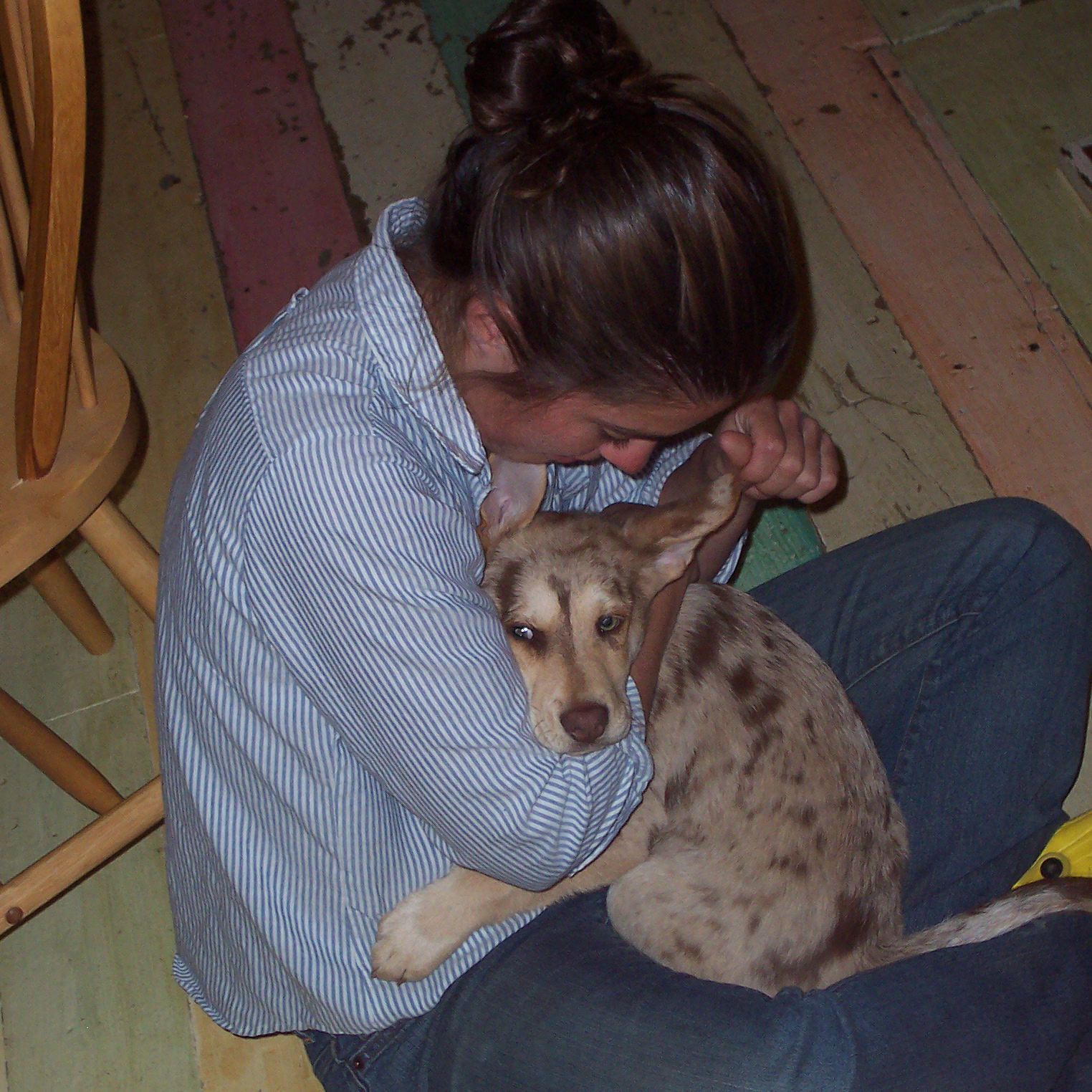
(Me and Noah, November of 2005. Photo by Jeff Taylor)

For a grad school environmental writing class, I wrote an essay about my experience as a volunteer in post-Katrina Biloxi, Mississippi. I was there from about Halloween to Thanksgiving in 2005—I wasn’t going door to door, counting and removing bodies, and seeing the worst, but I certainly wasn’t seeing the best either.

One of my classmates mentioned that I didn’t seem to have “relative distance” from the events I was writing about.

I am under no illusion that the troubles exposed and or caused by Katrina have gone away into some distant past, nor—despite a monumental recovery effort on the Gulf Coast—do I find much evidence that the root causes of the hurricane and aftermath have been addressed. I’ve found it hard to attain and maintain relative distance about Hurricane Katrina when my days begin with the hopeful and anxious snout of my Biloxi-born dog poking into my face.

For the last ten years, since my time in Biloxi, the puppy I adopted from there has been my constant companion. I was twenty-three with commitment-phobic gypsy tendencies, an allergy to plans, and a slim flash of understanding that a dog would likely complicate my life. All of these logical thoughts were overridden by the cuteness of the puppy amidst the wreckage of the Gulf Coast, the heft of his little body held relatively safe in my arms, and by my dad—wanting to do more himself about Katrina—cheerily bellowing into the phone that I ought to “just bring the damn dog home!”

So I did. And, with very few exceptions, wherever I’ve gone, so has Noah. He’s been across the country six times, lived in four states, ten towns, and with over twenty-five housemates. I can’t count the miles he’s hiked with me, the number of poop bags I’ve used, the hours I’d spend just scratching his ears.

And, despite a few idiosyncrasies, he’s a mostly happy pet. His story has had a pretty good ending—born out of a storm and living a life surrounded by people who love him, with a world to romp in, soft places to sleep, and food at regular intervals.

This dog doesn’t loom over my life and thinking like a Cassandric reminder of Hurricane Katrina, of deeply rooted national race and classism, of bureaucratic ineptitude on a deadly scale, of broken infrastructure, of climate change.

Except, sometimes, he does.

Why do I have this dog? Because the world fell apart.

And the world falls apart, constantly.

When I can stomach it these days, I follow the news. Droughts destroying food production. Fires burning up forests and towns, homes. Wars of faith and greed, killing innocents and sowing grief and horror. Carbon emissions rising and rising, the weather becoming unpredictable, the climates unrecognizable. Politics that are more anger than brains, with the heart almost totally lost.

Is it any wonder that people are desperate, are streaming out of their homelands, emigrating in search of peace, safety, and the resources to rebuild their lives?

Looking smaller, I can and do see the seeds of good change: almost everyone I know owns a bike and uses it regularly, small farms and local markets are growing in huge numbers, solar panels are increasingly normal, the economic collapse forced people to live and think a little smaller and smarter, America is beginning necessary and uncomfortable conversations about our racist culture and these movements are led by black people rather than liberal white politicians, more people than ever agree climate change is human-caused, and so on.

But when I look to the root causes of everything, of what causes the climate to turn California’s farms to dust, to burn up the West, to melt Iceland and freeze Atlanta, to flood Tuvalu, New York City, England, what causes so many parties to rub sharp elbows with each other in the Middle East, it all comes back to the simple fact that we use too much fossil fuel.

All of the post-crisis solutions—from rebuilding New Orleans to small scale local farming and creative zoning to make communities more walkable to the grounding constancy my weird little dog has provided me personally to opening borders to crisis-made emigrants—all of these are good and necessary and somewhat beautiful in the way that repair is a sign of love. We like to say that the best of humanity comes out in the darkest of times. I agree, I’ve seen it, and even been a better self when the chips are down—but I believe that the pat phrase takes responsibility for causing the darkest of times away from humanity ourselves.

Because who else causes war, burns the carbon that mutates storm cycles, puts other people in unventilated trucks, takes bribes and ignores crumbling infrastructure?

No God or ecological system I could believe in would do so, which leaves us mortals who run everything else on the planet as responsible for most of the evil stuff.

With every press of a power button, mile driven or flown, unthinking purchase, we participate in creating the darkest of times for someone else. It is not a clear line between powering up the computer—even to write about climate change and global justice—and floods, fires, famine, and refugees, but the links are there, and obvious once you start to look and think beyond the headlines, once you erase the relative distance between yourself and the world.

We are all culpable, and at this point, it’s not about becoming more or less guilty than your neighbor, or about self-importantly justifying your own actions[1]. We are in this together, from the most liberal off-the-grid hippy to the Koch brothers. We are a culture of unthinking and selfish rapacity, and in our ignorance is our hideous complicit culpability.

Reversing that, I would like to see a culture of thoughtful minimalism, that from our intelligence, that from our interconnectedness, from our ability to be the best in the worst of times, comes an awareness and responsibility to live the solutions daily.

We will not, cannot, stop the storms and upheavals that previous actions are already causing, but we can, we must, stop our habits and cycles before the world falls apart completely. Let our hearts grow larger and our own needs grow smaller. Let us be our best, always.


[1] I carpooled home from a climate change rally a few years ago with a young activist who argued that she needed her phone, laptop, and constant electricity and internet because of the difference she was trying to make in the world, but that other people should use less than her. If someone needs the same to keep in touch with loved ones, is that a less worthy use? It is a foolish and furious road to go down—trying to equate and supersede your choices above others.

Sunday, August 9, 2015

On Recreation and Conservation


(From the rebuild of Madison Springs Hut, 2010)


Some of my earliest memories are of being at Mizpah Spring Hut when I was two years old. These are not clear memories—I have scraps of images of being in a bunkroom, in a bunk bed, of the place being filled with men with beards and women with braids—but they are distinct from the photographs my parents took of my older sister and I on the trail and around the hut, so I trust them to be real memories and not re-imagined creations from the pictures.
I don’t know if it is the semi-primal nature of my earliest memories, but I have been drawn to wilderness and wildness all my life. Growing up, the huts themselves carried totemic significance to me as pinnacles within wilderness and mountains. I went to Lonesome when I was an infant, Mizpah when I was two, and Mizpah and Lakes of the Clouds when I was ten. That was all it took for me to fall hard for these beautiful and weather-battered places set amid the mountains. I wanted to be of that world, but saw the whole operation as something like aspiring to have Mt. Olympus as a neighborhood. My eyes perked up when I spotted patches from the huts on other kids bags at school, at summer camp, at college. I thought better of classmates from 4th grade through grad school when they knew anything about locations in the White Mountains.
When I was twenty-one, I began working in the AMC huts. That time of my life has been more formative than any other thus far. Many of my most cherished friendships come from those years, all those hikes, busy nights, and the quiet riot of watching sunset gold become starlight. In those many seasons, I learned to live in questioning balance with wilderness and sustainability, with conservation and recreation, and to appreciate the many uses of the National Forests. These mountains were what I thought of in order to live simply, think global, and act local. The thought of the migratory songbird Bicknell’s Thrush—who’s breeding grounds are the climatically endangered boreal zone of New England—have kept my electrical use low, bike use high, and put up more than one clothesline. With others, I helped to rename a mountain for Abigail Adams as a small act of equality up there. I have lived above treeline in three seasons, hiked tough and beautiful miles, and done some of the hard, strange, wonderful and dirty work that keeps these huts running.
Partly, of course, I was there for my own selfish love and for the all-defying joy of being in those wilder places. For a time, I felt I could no more leave the Whites than I could live without my skin. Partly, though, I was there because, as I cannot imagine my face or heart without them, I want to keep those doors open and latchstrings out for others to come into wildness.
And so, hearing of a proposal for a ninth hut, I am torn between wanting more openings to wildness for more people, and worrying about the ecological impact of further backcountry construction and appropriation for high-impact use.
The AMC and New Hampshire State Parks are proposing an additional hut to be built in Crawford Notch State Park. From what I understand, it would be staffed and operated by the AMC with a highly nuanced special use permit from the State, much as is used for Lonesome Lake Hut. The hut would sleep about 50 people, be staffed for full-service in summer and self-service in fall, winter and spring, and be a less than two-mile hike from Rte. 302.
When I think of all the young children who could fall in love with the wilds by coming to this place, who could grow up to be passionate, stumbling advocates for wildness, I soften towards the idea. Opposing it feels a bit like slamming the door to wilderness behind me, which is unkind and unfair.
However, one of the most important things I have learned because of loving the wilderness, that I learned whilst living cheek by jowl by septic field and gray water system and helicopter-removed human waste and solar panels alongside wilderness in the huts, is that these wild places in the woods and mountains are fragile. Resilient, too, but I truly cannot see enough reason to stretch the ecological forgiveness of wild places to new limits by building additional high-impact structures within their already much trammeled boundaries.
I can be defensive, selfish, and cynical regarding the protection and use of public lands. I know this. I do not have all the facts regarding this ninth hut, its conception, design, purpose or function. What I do know is that eight such highly impacted sites, as well as many campsites—staffed and unmanaged, legal and illegal—already exist in the relatively small area of the White Mountain National Forest. What I do know is that the cost of staying at a hut—adult member prices are over $100 per person on a weekday night in summer—is that they are increasingly prohibitively expensive for many , especially local or even in-state families. I believe it is reprehensible to continue to tie wilderness experiences, environmental education and outreach to socioeconomic class in an era of increasing awareness of climate change, classism, and culturally pervasive racism. Shall only the rich be allowed easy access to the soul-changing experience of a mountain sunrise, of the dawn chorus of birdsongs?
I know that the building of a hut is physically and ecologically hard, and that the workers are there for the love of the work, the place, and each other, not for munificent (or even consistent, year-round, living) wages.
I know that the NH State Park system has had some financial difficulties in recent years and budget cycles and perhaps whatever the agency might garner from a very special use permit seems like a solution in that regard. I know that hut occupancy has been on the rise, even as the rates increase, and perhaps another hut does seem the easiest answer to satisfy demand. I know that I find it strange how little publicity this proposal has had—the public comment period runs from July 17th-August 15th and two public meetings were held in New Hampshire. AMC members with young children, in the greater Boston area—the demographic most likely to support another family friendly hut destination—do not seem aware of this proposal.
I know that I—as an environmentalist who believes that much of climate change is the bastard offspring of our unquestioned cultural demand for “more”—am inherently distrustful of anything that involves more and bigger and new. I believe it would be better to work with what resources are already built—huts, campsites, hotels, and lodges—to achieve the goals of this proposed hut.
What I know most surely is that the thought of breaking new ground in protected landscapes flies in the face of what I learned to value intrinsically within those landscapes. I have loved seeing and being part of the AMC huts’ attempts to transition toward ever greener energies, design, and ideals. As mainstream culture chugs unchecked towards more, these places continually push for efficiency, for shrinking the ecological footprint, for protecting the landscapes even as they draw people deeper in. As a naturalist—both front and backcountry—I felt that it was part of my job to help people fall in love with the mountains and woods and lakes and starlight around the huts. As noted ecologist Dr. Sandra Steingraber has said, “what we love, we must protect.”
Even, I believe, from ourselves.
I write this achingly aware of the privilege I have had in all my mountain life—from my infanthood to Hutmaster-ships. I want those hills wild and open to the wise use of everyone. I want what happens to my heart at the sound of a white-throated sparrow above treeline to happen to everyone. I want as much of that landscape untouched as possible, because I believe it does us good and better as a people to let more wildness remain.
Until August 15th, public comments can be emailed to Johanna.lyons@dred.nh.gov or mailed to the Dept of Resources & Economic Development, Crawford Notch State Park Comments, 172 Pembroke Rd, PO Box 1856, Concord, NH 03302. If you have an opinion, share it there where it will do good. The public process is nil without an active and engaged public.

Monday, June 8, 2015

Of Farms and Fathers


Tonight, as I am preparing to return to the farm, I feel like the selfish boy from Shel Silverstein’s The Giving Tree, that I may be asking too much from something that only has so much to give.

All spring, through everything, I’ve been taking deep breaths and thinking that everything will be better, will get better, once I get back to the farm. The thought of the farmers already at work, of the seeds they’ve planted since March sprouting and growing has been a source of enormous comfort and an active hope that life will go on, that joy persists and will bloom.

But now here it is the night before and while I have my water bottle filled and my snacks packed and both my rain pants and sunhat dug out, I am afraid that I have leaned to much on the possibilities of a few acres, some friends, and hundreds of hours of work and pounds of vegetables.

Last year, working on the farm nicely popped me out of a funk following a bad breakup. People talk about the healing, grounding power of growing things. What I found was the delight of new skills and capabilities that expanded my bruised identity and a deep recalibration of what honesty looks like in the world. Those were good and great pieces to find then. In fact, I’d recommend farmwork for anyone who’s heart has been broken. 

However, all that foolish heartbreak and confusion barely even signifies beside what I am asking of the land this time around—to help me with the sadness of my father’s death. We have been saying it is like losing half the North Star.

To remedy that deep a sense of loss, a confusion of primal identity and omnipresent guidance seems too much to ask of anything—kindly tree, living person, or beautiful landscape.

When I lived in the mountains, there was tremendous temptation to anthropomorphize them, to believe that those mountains somehow cared as much for me as I did for them. While the farmland is a little more interactive, it still is a landscape with its own ecology, cycles and systems. True, my actions on the farmscape play more immediately into the layers of systems—human, vegetable, economic, woodchuck, etc.—than my actions on a mountaintop or beside the ocean do, but still, the land itself does not, will not, cannot feel empathy. The eggplants will not grow more beautifully in an attempt to comfort me, the potato beetles will not take the summer off out of respect for the bereaved, and so on.

This winter, when we thought my dad was merely depressed from retiring, he and I talked a few times about how excited he was to get back to building rock walls at the farm near my parents’ house and how excited I was to get back to my farm this summer. We missed our farm friends and we missed working with our hands and being able to see how we were useful. My mom put natural bug spray and poison ivy repelling soaps in both our stockings at Christmas.

Until last summer, neither my father nor I had ever worked on farms, or really expressed much interest in it. He was always busy saving New Hampshire and I was usually busy in the mountains. And, even though we talked over each other more than we listened to each other, it was more special than I realized at the time to have that common ground with him, even if our farms were in different states, even if he eschewed having anything to do with the vegetable side of farming, even if I told him he wasn’t really a farmer but a stonemason on a farm. He was a stickler for correctness and passed that critical nature right on down. The important things, though, the true things, are that we each made farm friends and did a lot of good soul searching and were delighted to put our hands in the dirt with other people every day.

At the hospital, there was a window that Dad could walk to for most of his first week there. The window looked west from Concord Hospital, up the hill towards my parents’ house, not quite visible beyond the crest of trees. The farm my dad had fallen in love with, though, was right at the top of the hill, its big yellow house and barn fully visible. On the wonderful day when my sisters and mother and I managed, with the help of some kind and resourceful nurses, to get Dad outside in a wheelchair for some fresh air and to see his beloved dog, as I wheeled him back up, I took him past the window to see the farm.

“I want to get back there,” he said, his voice raspy with dehydration and hope and fear.
“Okay,” I said. “Then you will. And we’ll compare notes from our farms all summer.”
I am not sure, but I do not think he went back to that window again.

One of my saner coping strategies, from even a few days before he died has, been to try to enjoy things twice as much, because the world has lost one of its biggest, loudest, most exuberant fans. As I have been taking my deep breaths and ticking off days on the calendar until I get to the farm, part of the hopeful belief that working on the farm can heal some part of this grief is the need to get back to a hue of joy that I shared with my dad. Even if I can’t call him to swap stories about blisters and hear what’s growing there.

And that is bittersweet.

But, fortunately, this joy is not something that is beyond the land’s capacity to give. To receive that, all I have to do is follow my family’s de facto motto and just show up. 

Sunday, May 17, 2015

Accident, Boylston Street


Twenty-five months and two days is a long time. Think of the thousand visions and revisions that your life has gone through in those hours. Babies have learned to run, trees have put forth blossoms and born fruit—twice, birds have flown and returned and flown and returned, tides have ebbed and flowed, people I loved have left my life and others have arrived, and all the rest that happens in the minutes of life.
 
On Friday, just minutes before I heard from a student that Dhzokhar Tsarnaev is to be killed for the acts he committed those same twenty-five months and two days ago, I read one of my most favorite poems at a library event. Jill McDonough’s beautiful “Accident, Mass. Ave.” In May of 2013, just a few weeks after the Marathon Bombings of April 15, when much of Boston was posturing pain and confusion behind angry words of pride and vengeance, when crowds gathered to protest outside the funeral home where the body of Tamerlan Tsarnaev lay, I heard McDonough read her poem.
 
I love it because it has the funny, knowing belligerence of Boston drivers, and the deeper resonance of how to be a human, anywhere.
 
Her words changed how I see the world, how I try to encounter challenges and upsets, how I try to distill my anger to an empathy for another’s fear.  It is uphill work, it does not work every time, and I contain far too much passion to lose all my anger, all the time, forever.
 
Yet, here we are, twenty-five months and two days later and the news is again full rehashing the bombings, full of the death penalty, full of what I suspect to be hope-desperate statements about how Boston is a strong and resilient city, how now we can put this horror behind us, how now everyone can move on in peace, now that the young man behind this circus of horror will be gone.
Couldn’t the strong and resilient people have found in their hearts and minds to not kill another person? Vengeance and honor killings, these are weak and medieval.  
 
To me, this sentence looks to be the work of vengeful and furious and frightened people, not wise and loving and resilient.
 
One friend, as we grapple with the sadness of all of this, says that one source of comfort to her is that the conditions of life in prison are so deplorable that it makes Death Row look a little more humane. We wince at this—the recognition that the conditions of our justice system make death preferable to life.
I am going through the grieving process for my own father—who probably wouldn’t agree with much of what I am writing here about the Marathon Bombings, except for the healing power of the McDonough poem—and I think of how death does and does not erase the living. In some ways, my father is more present in my thoughts now than any time while he lived. I know too that a natural death, brought on by a pernicious disease, is different than a State mandated death.
 
But, in the end, not so very different. Someone who was there, breathing air and looking at the world, suddenly is not.
 
My father is not erased. The echo of his laughter, of his actions, of his struggles and successes and passions will linger—thankfully—as long as anyone remembers him. The impact he had on those around him did not disappear when he drew his last breath.
 
This is not unique to my father and his death.
The Death Penalty, also, does not erase the actions in life of the condemned. My heart hurts when I see people around Boston, running and walking on prosthetic legs. I have started running in part because I can and recognize it as a privilege—much like voting or the other perks of a non-persecuted and free life. I am not ignorant or immune to the effects of the Marathon Bombings on the lives of those in this city, in this world. I do not think that Tsarnaev should walk free into the world and if we surround him with light and love and forgiveness, legs and arms will grow back and the world will be at peace.
The ghosts and bogeymen of his actions will outlive him, would have outlived him if he lived in solitary confinement to be a thousand.
One of the falsest things I’ve heard on the news is the statement about how we are not afraid, how the terrorists failed because we are not afraid.
 
Look at gun laws and the lack of them, at increased security measures in all corners, at the hyper-emotional level of newscasts, at panicky headlines, at increasing religious and racial and political intolerance, and all the rest of the news and changes in how we are in this world, on this planet, towards each other…these, to me, appear to be actions of extreme fear, not of resilience or strength. We are trying to protect against the threats of a world.
We are just scared, aren’t we?
 
Do you breath a sigh of relief when you say this? To admit fear feels, to me, like dropping the posturing and the pretense, like being honest and finally able to advance to somewhere useful and real.
Death does not solve fear. We push away, kill, hide what we cannot comprehend, what we fear. This buries it, puts the monsters under the bed, the witches in the forests, the ghosts in our nightmares, the seeds of violence in the dreams of the marginalized. We will not become a safer and kinder people in a grander and more understanding society by killing what we fear.
 
I believe we would be on the road to being a safer and kinder people on a more peaceful world by seeking to live in the present we’ve created, by using our strength as a bastion of world power and culture to demonstrate mercy, to value all life, to admit, accept, and move forward from fear.

Saturday, April 25, 2015

Silver Bullets, Wool Coats, and Love


The last afternoon before spring vacation, an assembly at the middle school where I work made me cry. Technically, the assembly was full of announcements and reminders about cleaning out their lockers before going on vacation, about not texting at school, and about the upcoming construction project at the school which will require patience, obedience, and flexibility on everyone’s part.

If it were just announcements, I wouldn’t have found myself tearing up. All of this information was presented in a series of short funny videos that teachers had made. The final one was a music video of various teachers lip-synching to Wilson Phillips “Hold on For One More Day.” It was absurd and beautiful and filled with the joy that these teachers find and make among their students.

We rarely see the love that holds the world together, that shapes our lives. Those hundred seventh and eighth graders have no concept of how dearly their teachers love them, what joy they have in teaching them. And it is too heavy and strange a thing to place on students to say: “we are here for you, we are rooting for you, we love how and who you are now, and how and who you will be later.” You can’t say that in a way they will understand. But you can take a few hours and create a video and make them laugh and feel safe. And that is something the same as love.

A week or so after that middle school assembly, I was in the hospital, visiting my dad. With the fresh recognition that most actions worth noting are an articulation and permutation of love, I began to see the tubes of medicine and oxygen pumping into his ailing self as some medical transmogrification of love. What the flowers on the windowsill said was love, the pictures on the wall, the cards, the strangeness of his own prayers over each course of drugs, the nervous, hopeful footsteps of his visiting friends, his ability to still make jokes with his daughters, his own need for my mom to hold his hand until he slept and to write down all his plans for their house—all of it was love being poured into different shapes and containers.

Lately, my favorite line from Thornton Wilder’s Our Town is when Emily revisits her twelfth birthday and, with the poetic clarity of a dead character, can see the amorphous, omnipresent love imbued in every mundane word and gesture and action on an ordinary morning. “So,” she sobs, “all of that was going on and we never noticed…”

It’s hard to notice, all the time. And, much as I might hope otherwise, I know that love is so deeply buried under all sorts of other harder emotions and motivations that we need mining gear and scuba suits to find it. But I believe love is there, is always there, and going on all the time if only we can believe it.

I think of love much like I think of the limited, shifting, innumerable molecules of known elements in this world. Matter is neither created nor destroyed, and nor is love. Like the twisting chains of molecules that become a leaf, a robin, a plastic i.v. bag of saline, an ocean, so love morphs and grows and braids among everything that is and was.

Love, though, is not a panacea. A chirpy video does not insulate middle school students from the personal struggle of adolescence. Love in all its many forms and immeasurable volume, and from so many hearts, did not keep my dad alive.

Still, it is the best thing we have. Love doesn’t halt or erase the awfulness of life. Rather, love highlights and is the wonderfulness of it all. Love is a thick wool coat against the cold, not a stopping of the howling winds.

In these first weeks of learning how to live with a Dad-sized hole in my life, I am trying to be better at seeing all the love that is always going on. I want to use my words and actions and life to wrap around who and what I love so that fewer sharp or icy or unwelcome troubles touch them. I want to be patient and grateful and dig deep to see the love underneath everything. Following another line of Wilder’s advice, I hope to slow down and take the time to look at everyone, knowing how little time we have. I know I will fail and fall down on this task, but I trust that I will always rise up and try again another day.

One morning in the hospital, my dad was opening a sheaf of cards that had just arrived. “Jesus Christ,” he joked with his singular gleam in the eye and glittering chuckle, “I can’t possibly owe this many people money…they must actually like me.”

Let’s no longer wait for the crises and eleventh hours to wrap each other up in love. Love may not be going anywhere, and will not stop the winds outright, but we will not always be here to say and do what we might, however the words come out of our hearts and minds and hands.

My wonderful dad, bull-trout riding in Missoula, Montana, in 2009.